Empowered Choice: A 2026 Guide to Contraceptive Methods in India
In a world where we track every step, every calorie, and every cycle phase, having autonomy over our reproductive choices is the ultimate form of self-care. Yet, for many women in India, the conversation around contraception remains shrouded in myths, clinical jargon, or cultural hesitation.
At Bloom, we believe that the best contraception is informed choice. Whether you’re looking for a temporary solution, a long-term plan, or an emergency backup, India’s contraceptive landscape has evolved significantly. In 2026, the focus has shifted from mere "population control" to reproductive autonomy—putting the primary decision-making power back into your hands.
In this guide, we break down the latest methods available in India, from government-backed schemes to premium hormonal innovations.
1. The Non-Hormonal Revolution: Chhaya (Centchroman)
If you’re wary of hormonal side effects like mood shifts or weight gain, India offers a unique, home-grown solution that has gained global recognition.
- What it is: A non-steroidal, non-hormonal oral pill.
- The Routine: Taken twice a week for the first three months, then just once a week.
- The Bloom Benefit: Because it doesn't utilize estrogen or progesterone, it doesn't mess with your natural hormonal symphony. It works by preventing the fertilized egg from implanting in the uterus.
- Accessibility: Available free at government centers as 'Chhaya' and privately as 'Saheli'.
2. Long-Acting Reversible Contraception (LARCs)
For those with a busy lifestyle who don't want the "daily pill" mental load, LARCs are the gold standard for efficiency.
The Antara Program (Injectables)
The Antara injection (Medroxyprogesterone acetate) is a highly effective method that provides 3 months of protection with a single shot. In 2026, many private clinics also offer the Antara-SC, a subcutaneous version that is less invasive.
Subdermal Implants
Gaining massive popularity in urban India, the single-rod implant (like Nexplanon) is a tiny matchstick-sized rod placed under the skin of your upper arm. It releases a steady, low dose of progestogen for 3 years. It’s the closest thing to "set it and forget it" in modern medicine.
Intrauterine Devices (IUDs)
- Copper T (380A/375): Non-hormonal and effective for up to 5-10 years. It’s highly reliable but can sometimes cause heavier periods.
- Hormonal IUD (Mirena/Eloira): These release a tiny amount of progestogen locally in the uterus, often making periods much lighter and less painful—a great option if you struggle with PMDD or heavy PMS.
3. Barrier Methods: Your First Line of Defense
While hormonal methods protect against pregnancy, only barrier methods protect against STIs (Sexually Transmitted Infections).
- Male Condoms: Easily available, but for maximum effectiveness, they should be used in conjunction with your cycle knowledge.
- Female Condoms: Providing more autonomy to the wearer, female condoms (like Femidom) are becoming more widely available in pharmacies across Tier 1 and Tier 2 cities.
- Internal Barriers: Diaphragms (like the Caya) are reusable and non-hormonal, though they require a bit of practice to insert—much like a menstrual cup.
4. Emergency Contraception: The Safety Net
Life happens. For those "oh no" moments, emergency contraceptive pills (ECPs) are available over the counter in most of India.
- Brands: I-Pill, Unwanted-72.
- The Rule: These must be taken as soon as possible, ideally within 72 hours of unprotected sex.
- Important Note: ECPs are a safety net, not a regular method. Frequent use can disrupt your cycle regularity. If you find yourself reaching for these often, it might be time to discuss a more permanent option with your doctor.
5. The "Natural" Way: Fertility Awareness & Tech
If you are highly attuned to your body, you might use the Fertility Awareness-Based Method (FABM).
By tracking your Basal Body Temperature (BBT) and cervical mucus, you can identify your "Fertile Window." However, as we discussed in our deep dive into Can You Get Pregnant on Your Period?, the biology of ovulation can be unpredictable.
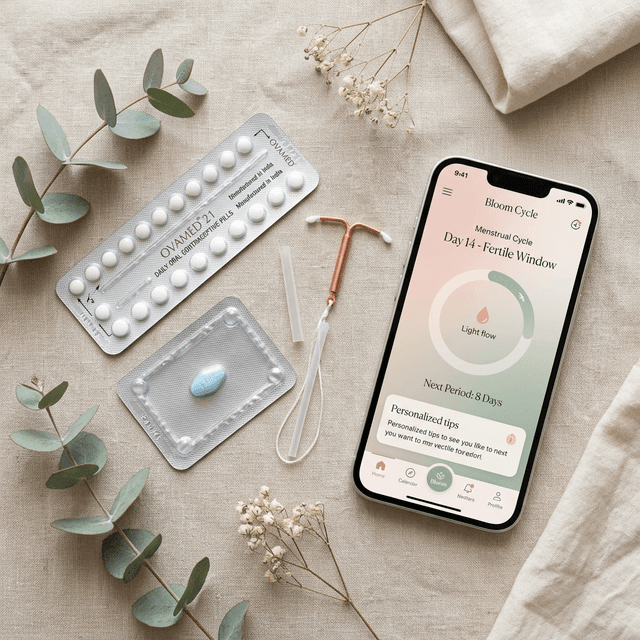
This is where Bloom comes in. Our adaptive AI doesn't just use a static calendar; it learns your unique physiological markers to give you a more accurate picture of where you are in your cycle, helping you make safer choices every day.
Making the Choice: The Cafeteria Approach
India’s Ministry of Health promotes the "Cafeteria Approach"—meaning you have a wide menu of choices, and the decision is yours.
When choosing, ask yourself:
- Do I want something hormonal or non-hormonal? (Check our guide on PCOS if you’re concerned about hormonal balance).
- How often do I want to think about it? (Daily, Weekly, 3-Monthly, or 3-Yearly?).
- Do I need STI protection? (Always use a barrier method with new partners).
Conclusion
Your reproductive journey is uniquely yours. Whether you choose the traditional Copper T or the modern subdermal implant, the goal is to feel safe, healthy, and in control.
Explore your cycle with Bloom to understand how different methods might impact your mood, skin, and energy levels. After all, your body is not a machine—it’s a landscape that deserves the best care possible.
Disclaimer: This guide is for informational purposes only. Always consult with a qualified gynecologist or healthcare provider before starting or changing any contraceptive method.
Read on the go.
Stop scrolling and start syncing. Download the free Bloom app for personalized daily insights right on your phone.