Can You Get Pregnant on Your Period? Myths, Biology, and Reality
There is a common misconception that menstruation acts as a "biological firewall"—a time of month where pregnancy is physically impossible. This myth has led to countless unplanned surprises and a general misunderstanding of how the female reproductive system actually functions.
At Bloom, we believe in radical health literacy. Let’s break down the science of why you can get pregnant on your period, the biological loophole known as sperm longevity, and how to track your cycle with precision.
1. The Myth of the "Safe Zone"
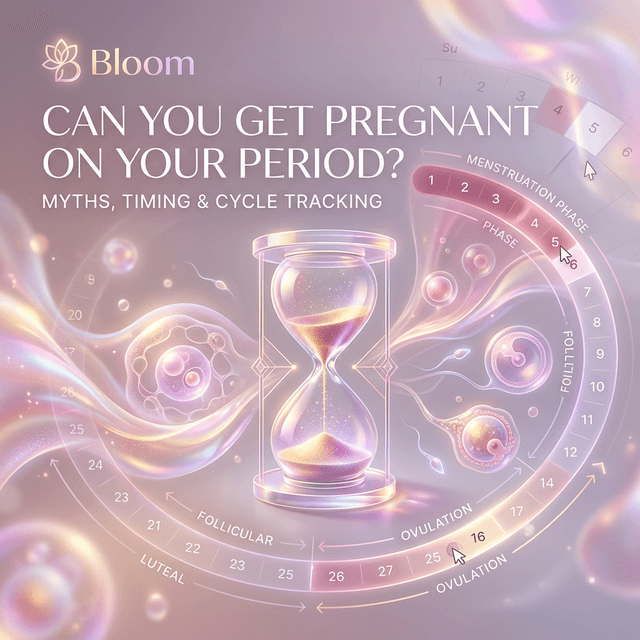
In a textbook 28-day cycle, ovulation typically occurs around day 14. If you have this perfect cycle, the chance of getting pregnant on day 2 or 3 of your period is statistically very low. However, textbooks rarely account for the beautiful complexity of real bodies.
Factors like stress, travel, illness, or even age can cause your body to shift its timing. If you have a shorter cycle or if your body decides to ovulate early, that "safe zone" disappears.
2. Sperm Longevity: The 5-Day Loophole
The most critical factor in "period pregnancies" isn’t necessarily when you have sex—it’s how long the sperm stays active.
Inside the fertile environment of the female reproductive tract, sperm can survive for up to 5 days.
Consider this scenario:
- You have intercourse on Day 5 of your period (when you are still bleeding).
- Your period ends on Day 7.
- You ovulate early on Day 10.
Because the sperm from Day 5 are still viable on Day 10, fertilization can occur. This is why timing is never as simple as "bleeding equals safety."
3. Why Some Cycles are Higher Risk
Not all cycles are created equal. You are at a higher risk of getting pregnant during your period if:
- You Have Short Cycles: If your cycle lasts 21–24 days, your ovulation window falls much closer to the end of your period.
- You Have Long Bleeding Phases: If you bleed for 7 or 8 days, there is almost no gap between your period and your fertile window.
- You Mistake Spotting for a Period: Early pregnancy or ovulation spotting can sometimes look like a light period, leading you to believe you are "safe" when you are actually at your most fertile.
4. Signs of Early Ovulation
Your body gives subtle cues when it’s preparing to release an egg, even if it happens sooner than expected. Watch for:
- Changes in Cervical Mucus: It becomes clear, wet, and stretchy (like egg whites).
- One-Sided Pelvic Pain: Known as Mittelschmerz.
- Increased Libido: A natural biological shift as you enter your fertile phase.
Learn more about Managing Stress Through the Four Seasons of Your Cycle.
5. Taking Control with Bloom
Counting days on a calendar is an outdated method of tracking fertility. To truly understand your body, you need a system that adapts to your data, not an average.
- Local-First Tracking: At Bloom, your sensitive health data stays on your device. We never sell your cycle history to advertisers.
- Symptom Mapping: By logging your cervical mucus, temperature, and mood, Bloom’s AI helps you identify your actual fertile window, regardless of when your bleeding starts or stops.
- Knowledge is Protection: Whether you are trying to conceive or trying to avoid it, understanding your unique rhythm is the most powerful tool you have.
The Bottom Line: Never rely on "being on your period" as a form of contraception. Use protection, track your data, and own your rhythm.
Want to dive deeper into your hormonal health? Explore our guide on Radical Self-Care: Holistic Women’s Wellness.
Dr. Monika Kaushik (CPO & Co-Founder) Empowering women through data-driven empathy.
Read on the go.
Stop scrolling and start syncing. Download the free Bloom app for personalized daily insights right on your phone.