Heavy Legs & Purple Lines: Why Women Get Varicose Veins (And How to Keep Your Circulation Flowing) 🦵💜🩸
At the end of a long day, do your legs ever feel like two heavy sacks of wet cement?
Perhaps you notice a dull, throbbing ache in your calves, subtle swelling around your ankles, or a roadmap of delicate purple "spiderwebs" and raised blue veins winding across your thighs and shins.
If this sounds familiar, you are far from alone. More than 50% of adult women experience some form of venous condition, from tiny cosmetic spider veins to swollen, bulging varicose veins.
Even more puzzling: many women notice their legs feel significantly more swollen, tender, and achy during specific times of the month—particularly in the week leading up to their period or during pregnancy.
Why are women so disproportionately affected by varicose veins? Is it just genetics and standing on your feet, or is there a powerful hormonal connection?
Let’s explore the science of venous circulation in simple, everyday language—and discover the daily rituals that keep your veins strong, light, and healthy.
🌊 How Your Veins Work: The One-Way Elevator System
To understand why varicose veins develop, it helps to look at how blood travels through your circulatory system:
┌─────────────────────────────────────────────────────────────┐
│                 THE CIRCULATORY CYCLE                       │
├─────────────────────────────────────────────────────────────┤
│                                                             │
│   1. ARTERIES (Downhill Express):                           │
│      Heart pumps oxygenated blood DOWN to your feet.        │
│      High pressure, easy flow assisted by gravity.          │
│                                                             │
│   2. VEINS (Uphill Battle Against Gravity):                 │
│      Must push deoxygenated blood UP back to your heart.    │
│      Relies on two special mechanisms:                      │
│        • The Calf Muscle Pump ("Your Second Heart")         │
│        • Microscopic One-Way Flap Valves                    │
│                                                             │
└─────────────────────────────────────────────────────────────┘
Because your veins operate under lower pressure than arteries, they cannot push blood back to your heart alone. They rely on:
- The Calf Muscle Pump: Every time you walk, bend your ankle, or take a step, your calf muscles squeeze the deep veins, shooting blood upward. This is why cardiologists often call your calf muscles "the second heart."
- One-Way Valves: Inside your veins are pairs of delicate, microscopic flap valves. When blood is squeezed upward, the valves snap open. When gravity tries to pull the blood back down between steps, the valves snap shut, locking the blood in place.
💥 What Causes Varicose Veins? The "Leaky Valve" Breakdown
A varicose vein happens when this elevator system breaks down—a condition known as chronic venous insufficiency.
    HEALTHY VEIN                        VARICOSE VEIN
  ┌──────────────┐                     ┌──────────────┐
  │  ▲ Flow Up   │                     │  ▲ Flow Up   │
  │  │           │                     │  │           │
  │ ┌┴┐         ┌┴┐                    │ ┌┴┐         ┌┴┐
  │ └─► Valves ◄─┘                     │  \  Valves   /
  │    Snap Shut                       │   \ Leak!   /
  │  (No Reflux)                       │    ▼       ▼
  │              │                     │ (Blood Pools │
  │              │                     │  & Stretches │
  │              │                     │  Vein Walls) │
  └──────────────┘                     └──────────────┘
- Valve Weakening: If the tiny flap valves become stretched, floppy, or damaged, they can no longer close completely.
- Blood Reflux & Pooling: Blood slips backward through the leaky valves and pools in the lower legs (venous reflux).
- Bulging & Twisting: Under the relentless hydrostatic pressure of pooled blood, the thin, elastic walls of the vein stretch, balloon outwards, and twist into visible, rope-like blue cords.
🌸 Why Women Are More Prone: The 3 Hormonal & Physical Drivers
Men get varicose veins too, but women develop them at roughly twice the rate. Here is why:
1. Progesterone: The Natural Vessel Relaxer
During the second half of your menstrual cycle (the luteal phase) and throughout pregnancy, your body produces high levels of the hormone progesterone.
Progesterone’s primary job is to relax smooth muscle tissue to prevent premature uterine contractions. However, progesterone doesn't only relax the uterus—it also relaxes the muscular walls of your veins. When vein walls relax and soften, they expand, pulling the delicate valve leaflets apart and allowing blood to pool.
This is why many women experience heavy, throbbing, restless legs in the 5 to 7 days before their period starts.
2. Pregnancy: The 50% Blood Surge & Pelvic Pressure
Pregnancy creates the ultimate storm for leg veins due to two simultaneous factors:
- Massive Blood Volume: To support a growing baby, a woman’s circulating blood volume expands by 40% to 50%, putting extra volume and pressure on every vein.
- Mechanical Pelvic Compression: As the baby grows, the enlarged uterus presses directly against the inferior vena cava (the massive main vein in your pelvis that drains blood from your lower body). This acts like a temporary kink in a garden hose, slowing venous return from the legs.
3. Estrogen, Genetics, and Collagen Elasticity
Estrogen also influences vessel elasticity. If your mother or grandmother had varicose veins, you likely inherited genes that produce more stretchy, compliant collagen in vein walls, making your valves more susceptible to stretching under pressure over time.
🔍 Spider Veins vs. Varicose Veins vs. Pelvic Congestion Syndrome
Not all visible veins are the same. Here is how to tell them apart:
| Type | How They Look | Common Symptoms | Location | | :--- | :--- | :--- | :--- | | Spider Veins (Telangiectasias) | Fine, thread-like red, blue, or purple webs flush with the skin | Usually painless; occasional mild burning or itching | Thighs, ankles, face | | Reticular Veins (Feeder Veins) | Flat or slightly raised blue-green lines (1–3 mm wide) | Mild aching; often feed into spider veins | Behind knees, outer thighs | | Varicose Veins | Thick, raised, twisted, rope-like bulging cords (>3 mm wide) | Heavy, throbbing ache, swelling, restless legs, cramping | Calves, inner thighs, shins | | Pelvic Congestion Syndrome (PCS) | Internal varicose veins in the pelvis/ovarian veins (invisible externally) | Deep, dragging pelvic ache worsening before periods or after intercourse | Lower abdomen, vulva, upper thighs |
🛠️ The Daily Circulation Toolkit: How to Relieve & Prevent Heavy Legs
While you cannot change your genetics, you can dramatically improve venous return, reduce swelling, and prevent existing veins from worsening:
        THE 4 PILLARS OF HEALTHY VENOUS RETURN

    ┌─────────────────┐       ┌─────────────────┐
    │ 1. GRAVITY DRAIN│       │ 2. EXTERNAL SQUEEZE
    │ Legs-Up-The-Wall│       │ Graduated Socks │
    │ (Viparita Karani)│      │  (15-20 mmHg)   │
    └────────┬────────┘       └────────┬────────┘
             │                         │
             └───────────┬─────────────┘
                         │
    ┌────────────────────┴────────────────────┐
    │                                         │
    ┌────────┴────────┐       ┌────────┴────────┐
    │ 3. CALF PUMP    │       │ 4. VASCULAR NUTRITION
    │ Ankle Flexes &  │       │ Rutin, Citrus   │
    │ Daily Walking   │       │ Bioflavonoids   │
    └─────────────────┘       └─────────────────┘
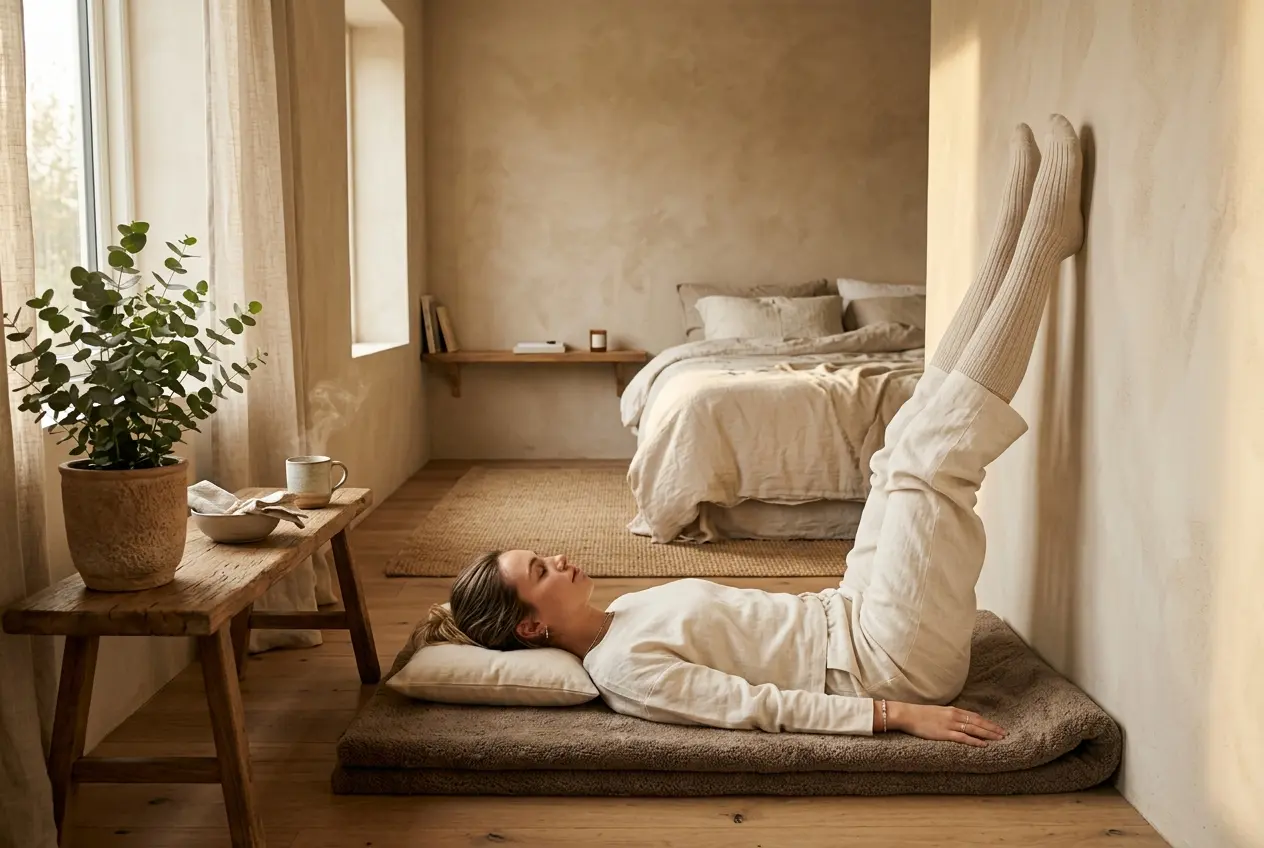
1. Legs-Up-The-Wall Pose (Viparita Karani)
- The Ritual: Lie on your back on a yoga mat or bed, scoot your hips close to a wall, and extend your legs straight up the wall at a 90-degree angle for 10 to 15 minutes every evening.
- Why it works: It uses gravity to effortlessly drain pooled venous blood and lymphatic fluid from your ankles back into central circulation, instantly relieving heavy, tired legs.
2. Graduated Compression Socks (15–20 mmHg)
- How they work: Unlike regular tight socks, graduated compression socks are tightest at the ankle and gently loosen as they move up the calf.
- The Benefit: This gentle mechanical squeeze narrows dilated vein diameters, helping floppy valve leaflets touch and close properly.
- When to wear: During long workdays (sitting or standing), long flights, and throughout the premenstrual week or pregnancy.
3. Activate "The Second Heart" (Calf Pumps)
- If you sit at a desk all day, perform 20 ankle pumps every hour: lift your heels high off the floor (tiptoes), then rock back onto your heels with toes pulled up.
- Take brisk 10-minute walks—each stride forcefully pumps venous blood upward.
4. Vascular Nutrition (Bioflavonoids & Vitamin C)
- Rutin & Hesperidin: Natural plant pigments (found in buckwheat, citrus fruits, apples, and berries) that strengthen capillary walls and reduce vessel fragility.
- Horse Chestnut Extract (Aescin): Clinically proven in multiple trials to reduce lower leg swelling and capillary leakage.
- Hydration & Low Sodium: Staying well-hydrated keeps blood moving smoothly, while limiting excessive processed sodium prevents fluid retention.
5. Quick Cold Water Rinses
- Finish your evening shower with a 30-second cool water rinse directed from your feet up to your thighs. Cool water causes superficial blood vessels to constrict (vasoconstriction), boosting vein tone and relieving heat and throbbing.
🏥 Modern Medical Solutions: When Lifestyle Isn't Enough
If varicose veins cause chronic pain, skin darkening (stasis dermatitis), or persistent swelling, modern vein medicine offers gentle, non-surgical outpatient treatments:
- Sclerotherapy: A tiny needle injects a specialized foam solution into spider or feeder veins. The solution irritates the vessel lining, causing it to collapse and naturally dissolve into the body over several weeks.
- Endovenous Thermal Ablation (Laser or Radiofrequency): Under local anesthesia, a thin catheter delivers gentle heat inside a large diseased vein, safely closing it. Blood naturally reroutes to healthy deep veins.
- Medical Adhesive (VenaSeal): A medical-grade cyanoacrylate glue seals diseased veins shut without heat or downtime.
🔒 Bloom’s Local-First Architecture: Tracking Swelling & Cycles in Private
Your menstrual cycle, fluid retention, and vascular symptoms are closely linked. Logging when your legs feel heaviest, how compression socks help, or when swelling peaks helps you understand your body's rhythm.
With Bloom, you can log your health symptoms with total peace of mind:
- 🔐 100% On-Device Encryption: Your cycle dates, symptom logs, and health notes live exclusively on your personal device.
- 🛡️ Zero Data Mining: Bloom never sells, monetizes, or shares your intimate biometric logs with data brokers or advertisers.
- 🔑 Optional Client-Side Cloud Sync: If you want multi-device backup, your data is sealed with private encryption keys that only you hold.
🚨 Safety Red Flags & Medical Disclaimer
- Normal Venous Insufficiency: Aching, heaviness, visible veins that worsen with standing and improve with leg elevation.
- ⚠️ Deep Vein Thrombosis (DVT Clot) Emergency Signs: Sudden severe pain, persistent swelling in only one leg, localized skin redness, and heat to the touch. Seek emergency medical care immediately if these occur.
Disclaimer: This article is for informational and educational purposes only and does not substitute professional medical advice, diagnosis, or treatment. Always consult a vascular specialist or healthcare provider regarding persistent leg pain, swelling, or circulation concerns.
Read on the go.
Stop scrolling and start syncing. Download the free Bloom app for personalized daily insights right on your phone.