Waking Up to Your Hormones: An Introductory Guide to Basal Body Temperature (BBT) 🌅🌡️🌸
When you think about cycle tracking, you probably picture calendar apps, period countdowns, or predicting fertile windows based on standard formulas.
But standard formulas assume every woman has a textbook 28-day cycle. In reality, our bodies are dynamic, and cycles fluctuate due to stress, sleep, travel, and nutrition.
If you want to know what is actually happening inside your body, you need a biological confirmation tool. And the most affordable, highly accurate, and scientific way to confirm ovulation is by measuring your Basal Body Temperature (BBT).
By simply tracking your waking temperature every morning, you can decode the secret dance of your hormones. Let's look at the simple science of BBT, how your hormones act as an internal heater, and the three rules for tracking it correctly.
What is Basal Body Temperature? (Your Body at Rest) 🛌😴
Your normal body temperature rises and falls throughout the day as you move, eat, and speak.
Basal Body Temperature (BBT) is your body's temperature at complete, absolute rest. Think of it as your body's idle speed.
It is the lowest temperature your body reaches during a 24-hour cycle, occurring while you sleep. To capture this resting speed, you must take your temperature immediately upon waking up in the morning—before you roll out of bed, check your phone, talk, or take a sip of water.
The Biological Space Heater: Progesterone's Role 🌡️🔥
Why does your resting temperature change? It all comes down to the shift between two dominant hormones:
- Before Ovulation (Follicular Phase): In the first half of your cycle, estrogen is the dominant hormone. Estrogen keeps your body's metabolic engine cool. During this phase, your waking temperature stays relatively low (typically ranging from 97.0°F to 97.5°F / 36.1°C to 36.4°C).
- After Ovulation (Luteal Phase): Once an egg is released, the empty follicle inside your ovary transforms into a temporary structure called the corpus luteum. This structure begins producing progesterone.
Progesterone acts directly on your brain's thermostat, serving as a gentle biological space heater. It raises your core resting temperature by 0.5°F to 1.0°F (0.3°C to 0.6°C). Your waking temperature suddenly jumps up (typically to 98.0°F / 36.7°C or higher) and stays elevated until your next period begins.
The Two-Step Dance: Reading the Biphasic Chart 📊🕺
When you log these daily waking temperatures on a chart, you will see a visual pattern called a biphasic pattern (a "two-phase" chart).
   98.4°F |                                  x  x  x  x  x  x  (High Phase: Progesterone)
   98.2°F |                               x
   98.0°F |                            x
   97.8°F |                         x
   97.6°F | -----------------------
   97.4°F |    x  x  x  x  x  x  x                       (Low Phase: Estrogen)
   97.2°F |  x
          +---------------------------------------------------
            Day 1         Day 14 (Ovulation)       Day 28
This clear, step-up shift in your chart confirms that ovulation actually happened.
Unlike ovulation predictor urine test strips (which only detect the brain's signal to release an egg), a BBT temperature shift is proof that the progesterone heater has turned on, confirming the egg was successfully released.
The Waking Rules: How to Measure BBT Correctly ⏰📏
Because the temperature shift is very small (often less than a degree), accuracy is critical. Think of measuring BBT like measuring a hair's width—you need the right tool and method:
Rule 1: Wake and Take 🛌
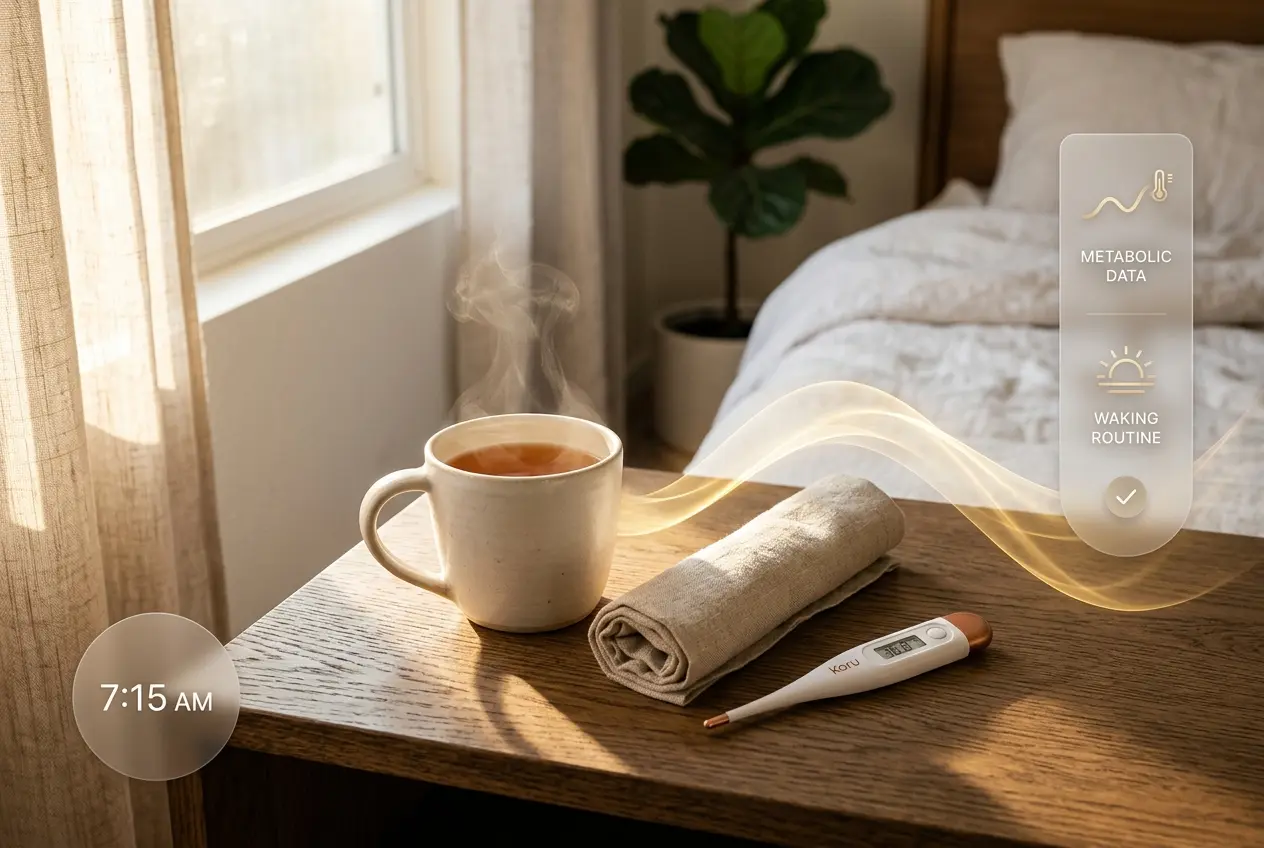
Keep your thermometer directly on your bedside table within arm's reach. The moment your eyes open, put the thermometer in your mouth before sitting up, checking your phone, stretching, or speaking. Any physical activity revs your body's engine, throwing off your resting temperature.
Rule 2: Keep a Consistent Waking Time ⏰
Take your temperature at roughly the same time every morning (within a 30-minute window). If you sleep in on the weekend, your temperature will naturally read slightly higher simply because you stayed asleep longer.
Rule 3: Use a Basal Thermometer 🌡️
A standard fever thermometer (a "yardstick") is not precise enough. You need a basal thermometer (a "precision ruler") that measures to two decimal places (e.g., 97.43°F instead of 97.4°F). These are easily found at local pharmacies.
Why Track Your Waking Temperatures? 🚀🎯
Tracking BBT gives you three major diagnostic insights:
- Confirming Ovulation: Know for sure if you are ovulating, which is vital for both trying to conceive and monitoring hormonal health.
- Predicting Your Period: Your temperature stays high during the progesterone phase. The day your period is about to start, the progesterone heater shuts off, and your temperature drops back down, giving you a natural heads-up before bleeding begins.
- Detecting Early Pregnancy: If your waking temperatures stay elevated for 18 consecutive days after ovulation, it is a highly accurate sign that the corpus luteum is continuing to produce progesterone to support an early pregnancy.
Chart Your Thermal Shifts Privately with Bloom 📊🔐
Tracking your daily temperatures, sleep notes, and cycle phases involves deeply sensitive biological information:
- Log Daily Temperatures: Record your two-decimal waking temperature.
- Log Cycle Disturbances: Note if you had alcohol, poor sleep, or a cold, which can temporarily spike your waking temperature.
Because your cycle charts and thermal logs are deeply private health records, Bloom utilizes a Local-First Architecture.
All your symptoms, waking temperatures, calendar logs, and thermal charts are stored locally and encrypted strictly on your own device. We never upload your data to public servers or share your records with advertisers. If you choose to enable cloud backups, your data is protected with full end-to-end encryption via Supabase, keeping your health records private, secure, and entirely under your own control. 🔐🌸
Disclaimer: This guide is for educational purposes only. Waking temperature tracking is not a foolproof birth control method on its own and should be combined with tracking cervical mucus (symptothermal method) and supervised by a fertility awareness educator for contraceptive use.
Read on the go.
Stop scrolling and start syncing. Download the free Bloom app for personalized daily insights right on your phone.